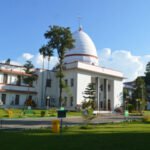

Tripura High Court: Korfa Cultivator’s Legal Heirs Cannot Claim Land Acquisition Compensation Without Proving Continued Cultivation
The Tripura High Court has held that the legal heirs of a Korfa, meaning an under-raiyat or cultivator, cannot claim a share in land acquisition compensation merely because the deceased cultivator’s name continues to appear in old revenue records. The Court said that the claimant must show that a valid and subsisting right existed on the date of acquisition. In the present case, the original Korfa cultivator died in 1986, while the land was acquired for NH-44 in 2015. Since there was no evidence that his legal heirs continued cultivation after his death, the Court rejected their claim for compensation.
Gist of the Case
The case concerned a claim for compensation arising out of acquisition of land for construction of NH-44. The petitioner, Santi Chiran, claimed compensation as the legal heir of late Dajindra Garo, who had been recorded as a Korfa cultivator in the revenue records. The petitioner argued that the rights of the deceased cultivator were inherited by his legal heirs and that they were therefore entitled to receive the compensation. The Court examined whether the old Korfa entry was sufficient to establish a continuing legal right when the land was acquired.
Facts of the Case
Dajindra Garo was recorded as a Korfa Raiyat, or under-raiyat, in respect of the land situated at Paschim Mog Puskarini. The revenue records showed his name as a Korfa cultivator, and compensation had been apportioned in his name in the acquisition proceedings. However, Dajindra Garo died on 6 March 1986, nearly three decades before the acquisition proceedings concerning the land.
After the acquisition, the petitioner and other legal heirs claimed that they were entitled to receive the compensation that had been apportioned in favour of Dajindra Garo. The petitioner submitted a claim before the competent authority in December 2025 and relied upon the survival certificate and a notarised power of attorney executed by the legal heirs. The competent authority rejected the claim, stating that the petitioner had not produced sufficient documentary evidence to establish her right and title or interest over the acquired land.
The petitioner thereafter requested the competent authority to refer the dispute to the District Judge under Section 3H(4) of the National Highways Act, 1956. According to the petitioner, the legal heirs had stepped into the shoes of the deceased cultivator and were entitled to the compensation. When the matter was not referred, the petitioner approached the Tripura High Court under Article 226 of the Constitution.
What is a Korfa?
The Court explained that a Korfa is treated as an under-raiyat under the Tripura Land Revenue and Land Reforms Act, 1960. An under-raiyat is a person who cultivates or holds the land of a raiyat under an express or implied agreement, usually on payment of rent or delivery of a share of the produce. The Court referred to Section 108 of the Act, which provides that the interest of an under-raiyat is heritable but, subject to the provisions of the Act, is not transferable.
The Court also noted that a Korfa is not the owner of the land merely because he is recorded as a cultivator. His right is connected with cultivation and his relationship with the raiyat or landowner. Therefore, the existence of an old revenue entry showing a person as a Korfa does not by itself prove that the same right continued for several decades.
Arguments of the Petitioner
The petitioner argued that Dajindra Garo had been recognised as a Korfa cultivator in the revenue records and that compensation had been apportioned in his favour. She submitted that after his death, his legal heirs succeeded to his rights and therefore they were entitled to receive the compensation.
It was also argued that the survival certificates issued by the Sub-Divisional Magistrate established the identity of the legal heirs. The petitioner further relied upon the power of attorney executed by the legal heirs in her favour to pursue the compensation claim. According to the petitioner, the competent authority should have referred the dispute to the District Judge under Section 3H(4) of the National Highways Act instead of rejecting the claim.
Arguments of the Respondents
The respondents argued that the legal heirs had not established any existing right or interest in the acquired land. They pointed out that Dajindra Garo had died in 1986 and that there was no evidence showing that the petitioner or any other legal heir continued to cultivate the land after his death.
The respondents also pointed out that the names of the legal heirs were never entered into the revenue records as Korfa cultivators. There was also no fresh lease, oral arrangement or documentary evidence showing that the legal heirs had continued the cultivation relationship with the landowners. The respondents therefore argued that the old revenue entry could not be used to claim compensation for an acquisition that took place many years later.
Court’s Decision
Justice Dr. T. Amarnath Goud dismissed the writ petition and upheld the order of the competent authority rejecting the compensation claim. The Court found that Dajindra Garo died on 6 March 1986 and that there was no evidence of continued cultivation by his legal heirs after his death. The acquisition took place in 2015, and the Court found a long gap between the death of the original cultivator and the acquisition.
The Court noted that although the legal heirs could succeed to the rights of the deceased cultivator, they first had to establish that the underlying right continued to exist. In the present case, there was no evidence of cultivation by the legal heirs, no mutation showing them as Korfa cultivators and no oral or documentary lease arrangement with the landowners. The Court therefore held that the legal heirs could not claim compensation merely on the basis of the old revenue records.
The Court also considered Section 3H(4) of the National Highways Act, 1956. The provision provides for reference to the competent civil court where there is a dispute regarding apportionment of compensation or the person to whom compensation is payable. However, the Court held that in the present case there was no legally sustainable claim requiring such a reference because the petitioner had failed to establish a subsisting right or interest in the land at the relevant time.
The Court further observed that the purpose of recognising the interest of a cultivator in compensation is connected with the protection of the livelihood of a person actually cultivating the land. In this case, the legal heirs had not shown that they were cultivating the land after the death of Dajindra Garo. The continued appearance of his name in the old revenue records could not, by itself, create an enforceable right to compensation.
The Court also referred to decisions of the Supreme Court, including Dr. G.H. Grant v. State of Bihar, Narendra Bahadur Singh v. State of U.P., Inder Parshad v. Union of India and Babu Ram v. State of Punjab. These decisions were referred to in the context of the principle that a person claiming apportionment of acquisition compensation must have an existing and legally enforceable interest at the relevant time. The High Court applied this principle to the facts of the present case.
The Court ultimately held that the petitioner and other legal heirs had failed to establish an enforceable right to claim the compensation. The order of the competent authority dated 28 January 2026, signed on 5 February 2026, was upheld. The writ petition was accordingly dismissed and any pending miscellaneous application was ordered to stand closed.
Case Details
Case: Smt. Santi Chiran v. The Competent Authority for NH 08(44)
Case No.: WP(C) No. 381 of 2026
Citation: 2026:THC:1338
Court: High Court of Tripura
Judge: Justice Dr. T. Amarnath Goud
Date of Judgment: 24 September 2026